The Giant, the Hairpins, and the History
My Tour de France Pilgrimage
C=CC Committee member Paul enjoys (and endures) a climby homage to his Tour de France heroes
My love of watching professional cycle road racing was slow to develop. As a kid, and then young adult, I spent a life behind (flat handle)bars, firstly on BMXs and then on mountain bikes. Drop-bar road bikes were oddities, ridden by strange skinny people who inexplicably didn’t like building ramps and trails in the woods. This disinterest lasted well into adulthood. My wife and I even enjoyed a July weekend in Paris decades ago and wondered, perplexed, what all the crowds and razzmatazz were (it turns out it was the traditional Paris ending to the three week Tour de France stage race). But my detachment didn’t last. Somehow, the sport crept into my consciousness, and before long I was hooked: The athletic endeavour, the heroism, the highs of success and lows of failure, the strange mix of team sport with individual reward, the (initially unfathomable) tactics, the history and tradition, the personalities (on and off the bikes) and the jaw-dropping vistas from countries afar. Oh those vistas. And few are more stunning than a peloton of professional riders speeding past golden sun-drenched wheat fields or winding up mountain hairpins in the Alps or the Pyrenees. These days I love watching most professional cycle road racing. But the cream de la cream has to be the Tour de France.
So, early this Summer, with a cycling itch to scratch, I headed to France to cycle in the footsteps of Tour heroes, and villains. As cycling race commentators will tell you, Le Tour is won and lost (usually!) in the mountains. I (also usually!) like a cheeky climb, so it was the mountains to which I headed. Travelling with a UK cycling specialist, my week, and that of my fellow customers, would take in 10 iconic climbs used, and re-used, in the furnace of Tour de France competition over Decades.
This is my tale, not of my aching legs, heaving chest, and eyes stinging with sweat and sunscreen (although there was plenty of all of these throughout the week). Instead, here’s just a taste of the feel, the look, the geography and the racing history of the iconic climbs I endured, I mean enjoyed…
Day 1: Mont Ventoux
Our adventure starts in the beautiful Provence countryside. We’re surrounded by lavender fields and very gently rolling hills. Apart that is, from Mont Ventoux. Unlike the Alps or the Pyrenees where peak after peak are squeezed into mountain ranges, Ventoux is a lonely outlier. The “Giant of Provence” is a stark limestone peak that dominates the skyline for miles around.
Of all the climbs we’ll attempt this week, this is the only one I’ve previously ridden. Its lower slopes are below the tree line, so provide some shelter from the sun. Above the trees Ventoux is a bald, barren almost moon-like rocky landscape, often battered by the wind even in the Summer. It’s quite unlike anywhere else we’ll visit all week.
The evening before our ascent, we enjoy a short leg-loosening ride out to a cafe in Bedoin at the foot of Ventoux. It’s a lovely hour or so, but tinged with sadness; the cafe is packed with cycling memorabilia, including an old Peugeot racing bicycle ridden by Tom Simpson. The much-loved British racing cyclist, surely one of the best ever, collapsed and died near the summit of Ventoux on the thirteenth stage of the 1967 Tour de France. Tomorrow we’ll pass his memorial on the climb. Just like my last visit, it’ll be bedecked with bidon water bottles and other cycling momentos still regularly left as a tribute to the man nearly sixty years after his death.
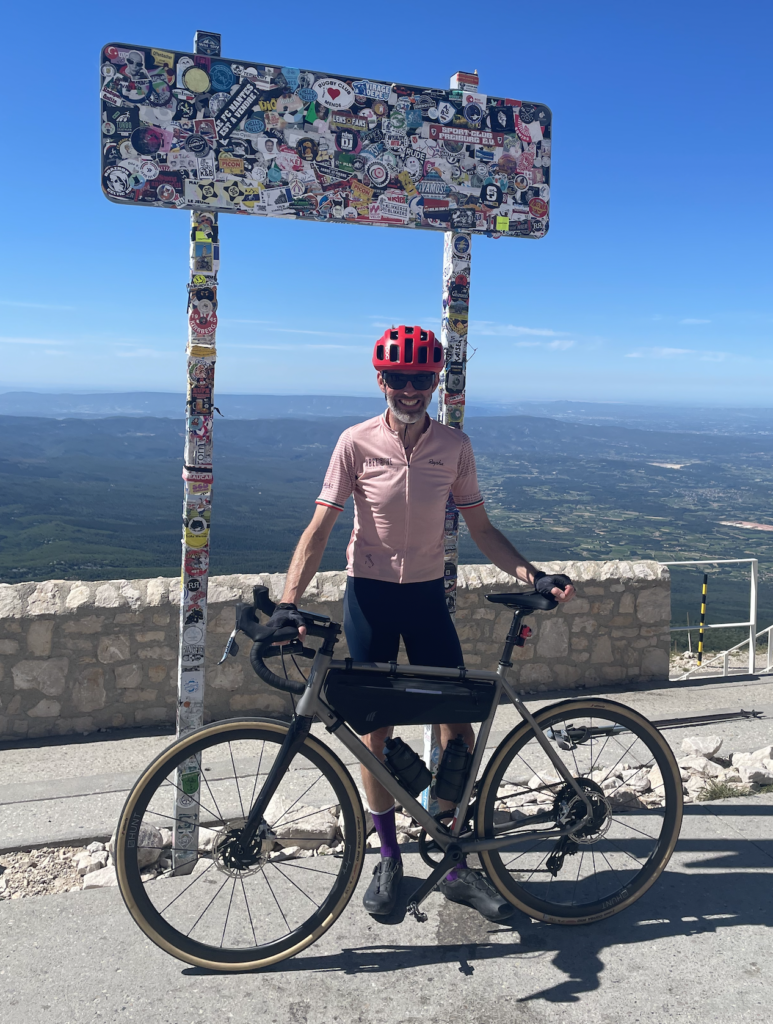
On the climb, Ventoux remains a big draw. Just as with my previous ascent I see all sorts of riders and bicycles tackling the challenge. Lycra-clad road cyclists, pannier-laden tourers, tandem riders, mountain bikers (e-assisted and non-electric), hand bikes and recumbents. They and more are all here pitting themselves against The Giant. I get up there, steadily, to the imposing brutalist weather station at the top. I’m taken back to 2018 when my cycling mate Ian and I slogged up the same climb, perhaps ill advisedly, in 35+ degree heat. Exhausted, scorched and dehydrated at the summit we enjoyed cold cans of Coke Cola from the tiny memorabilia shop there. Ian still claims he’s “Never tasted anything like it, before or since”. Descending back down, I stop and pay my respects to Tom.
Day 2: Col d’Allos
Today we’re heading north east, out of Provence towards the ‘Haute’ (high) Southern Alps. We see sparkling rivers, beautiful gorges and old Napoleonic forts converted to restaurants and cafes. Our main climbing task for the day is the Col d’Allos. The col was a regular feature on the Tour de France in the 1910s, 20s and 30s, but is used much less frequently in the 21st century.
It ends up my least favourite of the week. On the ascent, the toughest gradients are all back-loaded. So even if you feel sprightly early on you may well be (as I was!) heaving and grinding out a slow pedalling cadence near the summit. The descent doesn’t win my affection either. It’s narrow, cars coming up towards you often straddle the centre line (where there is one), the surface is often rough, and the precipitous drop to the valley below is on your nearest side. I engage a Mary Poppins-esque descending mode.
Day 3: Col de Vars and Col d’Izoard
Dual cols today; the Col de Vars and Col d’Izoard often appear as a pair on Le Tour. This area is the “Casse Déserte”, dominated by weathered rocky pinnacles and scree slopes. On this June day the heat is unwelcome; it’s the native ground of squirrels and marmots, not labouring sweating adopted Welshmen! The Izoard especially is a Tour favourite. Riders across the decades have done battle on its slopes; near the summit I pass memorial plaques to (Italian) Fausto Coppi and (Frenchman) Louison Bobet, both multiple Tour winners in the 1940s and 50s.
Day 4: Col de Lautaret and Col du Galibier
What a day! The Col de Lautaret is our first task. I love it! The gradient the whole way up is in the sweet spot I adore; enough to be a hill but modest enough to employ some carefully judged gusto! There’s a Danish cycling club in town. They have literally hundreds of riders spread out on the hill, chaperoned by guides setting a modest pace up its flanks. I fly by bunch after bunch of them on the way to the top. In an attempt to not appear like an idiot, time and again I issue “Bonjour!”, “Bon chance!” and the like as I pass. Secretly though, in my mind, I am the great Tadej Pogačar putting my General Classification racing rivals to the sword! Three quarters of the way up, a roadside support crew from the Danish club hand out water, shout encouragement, and dance enthusiastically to loud pumping music. It’s a party on the mountain! At the top of the Lautaret I stop for coffee and photographs. A couple of the Danish riders I’ve previously passed join me and get me to take a photo of them. We get chatting and when I’m asked if I’m from England I politely explain no, Wales, like Geraint Thomas. We guffaw loudly when one of them exclaims “YOU are Geraint Thomas”! I assure him I’m most definitely not, but am quietly proud to be even mentioned in the same sentence as one of my cycling heroes. Next, it’s the Col du Galibier; a real Tour favourite. After the flattering gradients of the Lautaret I’m more apprehensive about this one. I know from the elevation profile that the gradients will be steeper. But it’s beguiling. It’s not easy, even at my now more measured and extremely modest speed. But it’s manageable and, perhaps best of all, it looks and feels like a proper Tour de France climb. Rock and scree and snow (even in June) surround you. The names of fan favourite riders, teams and cycling clubs are painted on the road surface. Hairpins and sweeping bends cling to the mountainside. Occasionally, when the gradient kicks up, all you can see in front of you is tarmac and sky! The valley floor below stretches for miles into the distance. It might not have the starkness of Ventoux, but this is the landscape that my fan-boy mind conjures up when I think of a Tour de France mountain stage. For me it’s the highlight of the week.
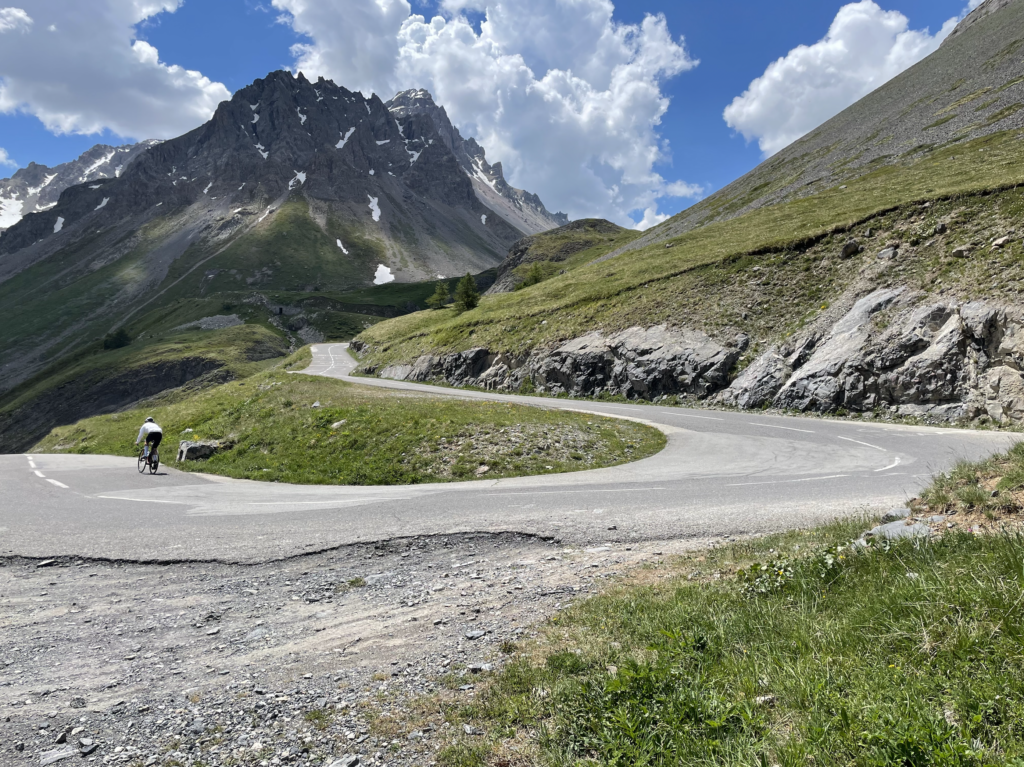
The Galibier descent is busy too. This mountain clearly draws the crowds like Ventoux does. The Danish club aren’t here now; they’re taking a different route down. Instead, like Ventoux, I see a real mix of riders as I descend. I see several solar power assisted hand and recumbent cyclists. But my biggest smile is reserved for the Border Collie trotting up the Galibier in front of his owner pedalling a cheap hybrid flat-bar bike and an empty dog trailer!
Unexpectedly, in a flash, I pass Remco Evenepoel. This professional rider from team Bora Hansgrohe is clearly between races and training on or recceing the Galibier climb (this year’s Tour will climb Galibier on the final mountain showdown of the race). He’s heading up as I’m riding down; our speed differential is embarrassingly small! Nonetheless it’s a lovely descent off the Galibier. In contrast to the Col d’Allos earlier in the week the back of the Galibier is a wide, open, smooth and sweeping descent. Even I feel a little fast down it (though don’t check my Strava!).
Day 5: Col du Telegraphe, Col du Glandon and Col de la Croix de Fer
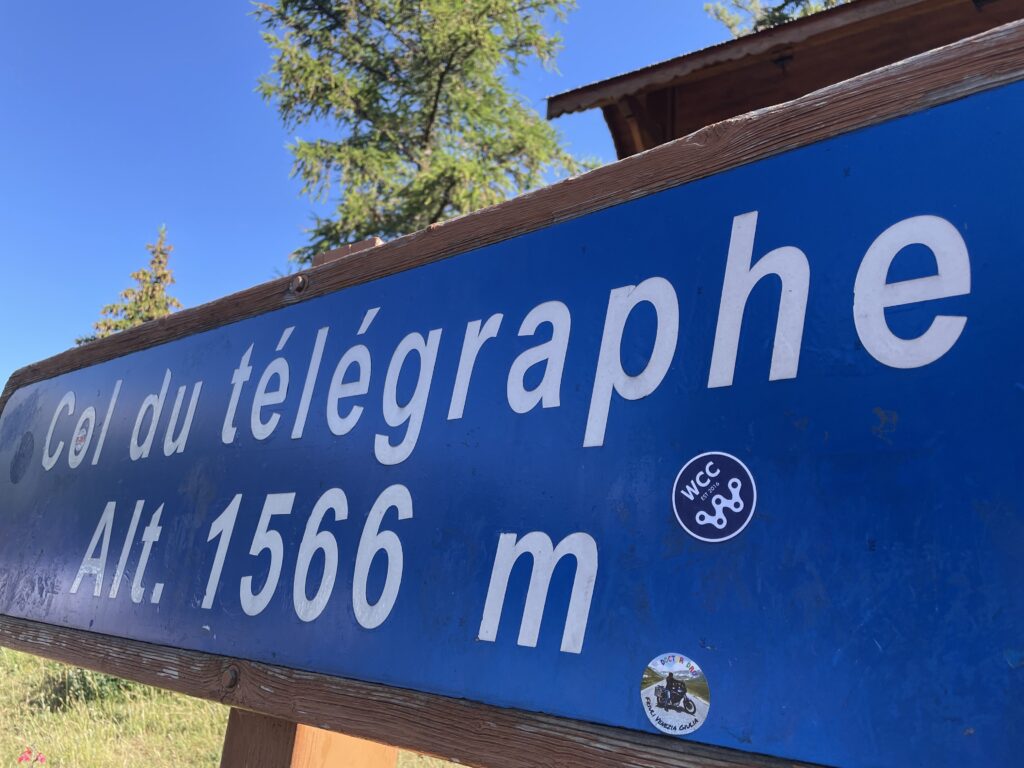
A three Col day looms. However, mercifully, we’re already high in the mountains so two (the Col du Telegraphe and Col de la Croix de Fer) are relatively easily won. The main business of the day is the Col du Glandon. It’s a long and eerily quiet ascent. We later discover that a landslide has closed the Col to all but bicycles. At the bottom the col is narrow and tree-lined and the mountainous terrain around us is frequently obscured. With the additional lack of any vehicle traffic this could be a mid-Wales climb. By the top the trees have gone, the mountains are all around, and the legs are reeling from gradients that once again kick up towards the summit.
Day 6: Alpe d’Huez
Today, distance-wise, is mercifully short. Good job, at breakfast our party is looking somewhat weary. Our last hurdle however isn’t an easy one. It might just be the Tour de France’s most iconic of all iconic climbs. Today, we ascend Alpe d’Huez.
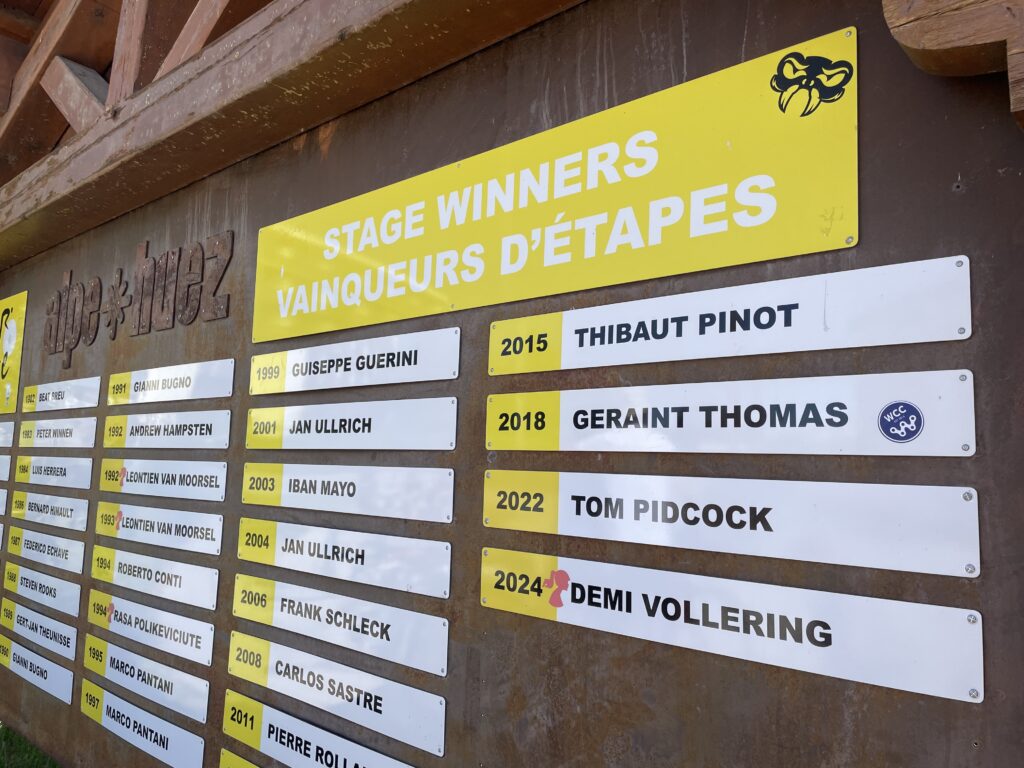
To me, Alpe d’Huez predominantly means two things: Chronologically, in the 2001 Tour de France, the climb was the setting for “the look”, immortalised by TV cameras, from (the now villainous) Lance Armstrong, appearing to glower over his shoulder at primary rival Jan Ullrich before accelerating away. More recently, and much more pleasingly, it provided a stage win for Geraint Thomas’s successful 2018 Tour de France campaign. At the time of writing, Welshman “G” remains the only male professional rider to win on Alpe d’Huez whilst wearing the Tour de France leader’s yellow jersey; “Alpe d’Huez, man!”.
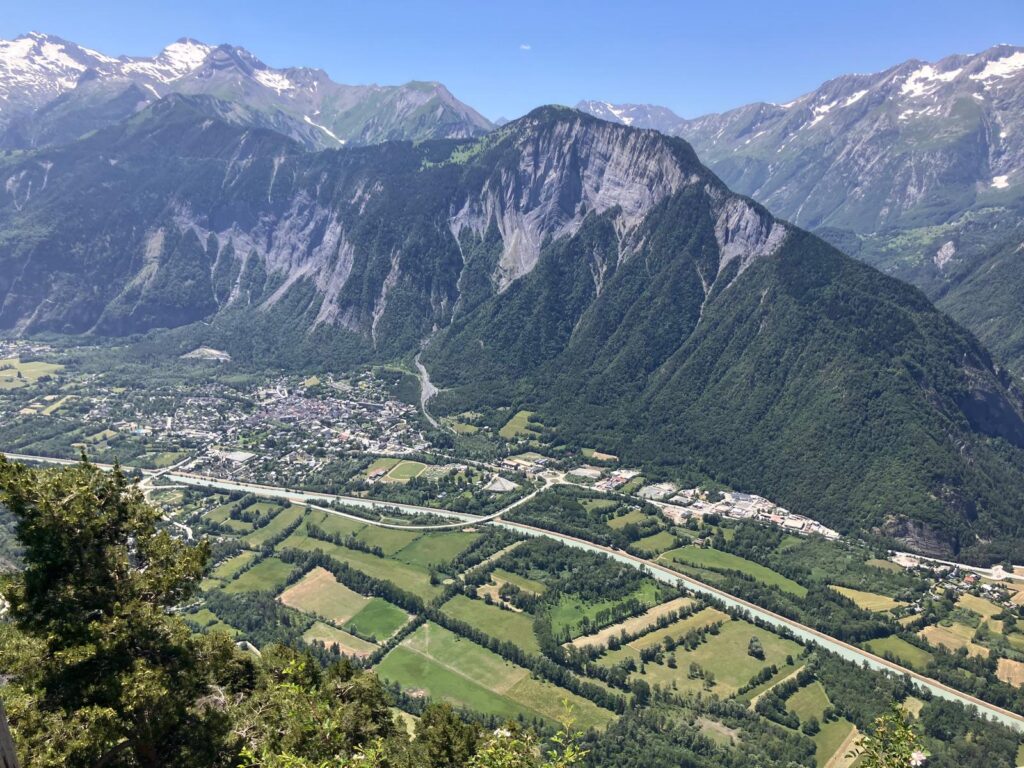
My own, far slower, ascent is an exercise in ticking off the hairpins (all 21 of them). It’s obvious early on that this is cycling holy ground: A steady stream of cyclists trudge up and speed down the twisting tarmac, and paint is daubed on the road all the way up celebrating both contemporary and historic riding heroes. The summit comes as a real relief after the week’s exertions.
Before descending we have lunch at a Creperie. The post-Ventoux Coke Cola effect kicks in again and after the earlier effort it tastes utterly amazing! To end the trip we freewheel (mainly) back down to Bourg d’Oisans for more gourmet French food and celebratory beers.
Touring Le Tour
So, that was my taste of some of the climbs on which the Tour de France is won and lost. It did nothing to diminish my immense respect for the athletes, men and women, who climb and descend these Cols in their quest for team and individual victories. Across my six days in the mountains I racked up around 550 Kilometres with a total of 12,000 Metres of ascent. Enjoy it though I did, by day seven I was happy to be heading home. I’m a bit broken.
The 21 stages of the 2026 Tour de France kick off with the ‘Grand Départ’ in Barcelona on Saturday 4th July. In contrast to my efforts, this year the men’s Tour will cover 3,333 kilometres with a brutalising total of nearly 55,000 metres of ascent! And, of course, this will be at racing speeds far, far in excess of my amateur trudging. And the threat of crashes and injury in the pro peloton is never far away. It’s truly a hard man’s, and hard woman’s, sport. Just one of the many reasons I’ve come to love it. Vive le Tour!
Notes: Paul travelled with https://www.skedaddle.com/uk at his own expense. They were fabulous!