Norse code:
C=CC Committee member Paul ponders what Norwegians can teach us Cardiffians.
I love Cardiff. I love our wider Wales. I love the Welsh. But this isn’t a monogamous affection, and my latest cycling adventure demonstrates why.
Over three decades or so I have been lucky enough to visit Norway several times. I’ve never stayed for any great length of time. But each time I’ve visited I felt like I learned a little more about the country and its people. And, to my mind, there’s much to love. This latest trip I was really excited about. Until now, almost all my time in Norway has been in its Winter months. With its northern latitudes and mountains this means snow, and plenty of it. Now there’s an undeniable beauty to a landscape draped in a blanket of snow. But I couldn’t help thinking that this latest Summer trip might reveal the country’s true beauty below. In addition, this would be the first time I’d cycled in Norway. And we all know that cycling is the best possible way to see a country!
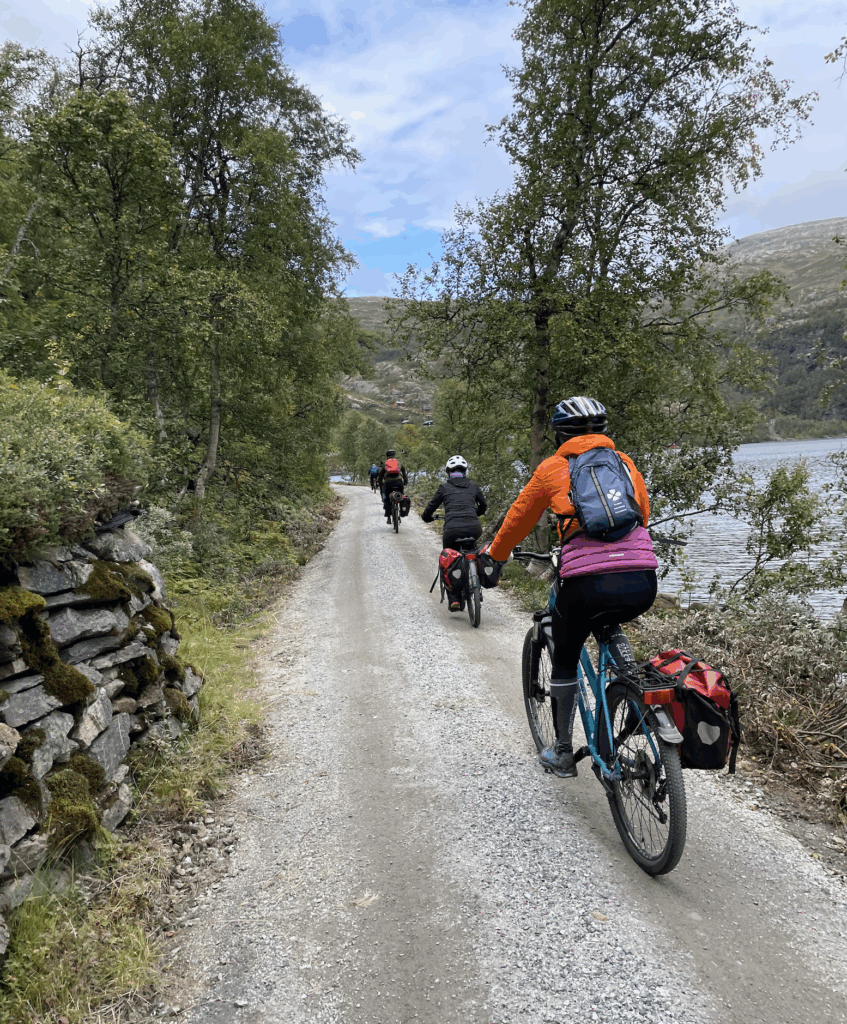
I travelled with a UK cycling specialist, specialising in off-road events and trips in the UK and abroad. They promised four full days of supported cycling taking in deserted gravel tracks and bucketlist scenery. It didn’t disappoint.
I arrive in Norway with a little time to kill. Breakfast in Oslo was an early reminder of some of the things I love about the country. TripAdvisor found me a bustling cafe with a breakfast buffet. It was packed full of fresh local unmolested foodstuffs. Anyone craving hash browns, chips, chicken nuggets and the like at mealtimes may find that Norway’s culinary norms don’t appeal. Apparently there are around 1500 McDonalds “restaurants” in the UK; Norway has just 70-odd. A word of warning though: One of the ladies in our holiday group was vegan. She sometimes struggled to find suitable food; Norwegians are quite carnivorous!
Later in the day our newly acquainted group of holidaying cyclists is bused north from Oslo up into the mountains. En route we pass Lillehammer, still celebrating its 1994 Olympic Winter Games. As the mountains loom larger and larger, anticipation sets in. Tomorrow is our first day of cycling.
Accommodation over the four days comprises mountain lodges and hotels. In the Winter they serve skiers and snowboarders. In the less wintery months they gladly embrace cyclists and walkers with the often capacious skiing kit drying rooms serving as excellent secure cycle storage. Not that security is a concern. As our local guide keeps reminding us nervous Brits, “this is rural Norway”; nobody uses a bike lock all week, at any of the hotels, cafes or restaurants we stop at.
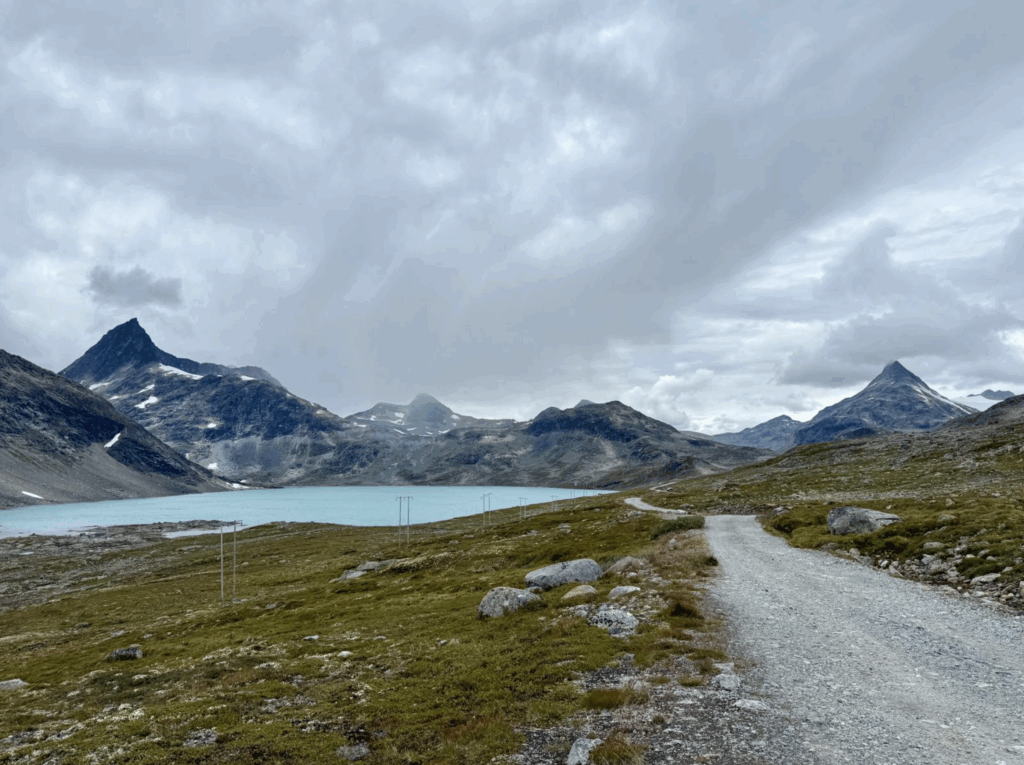
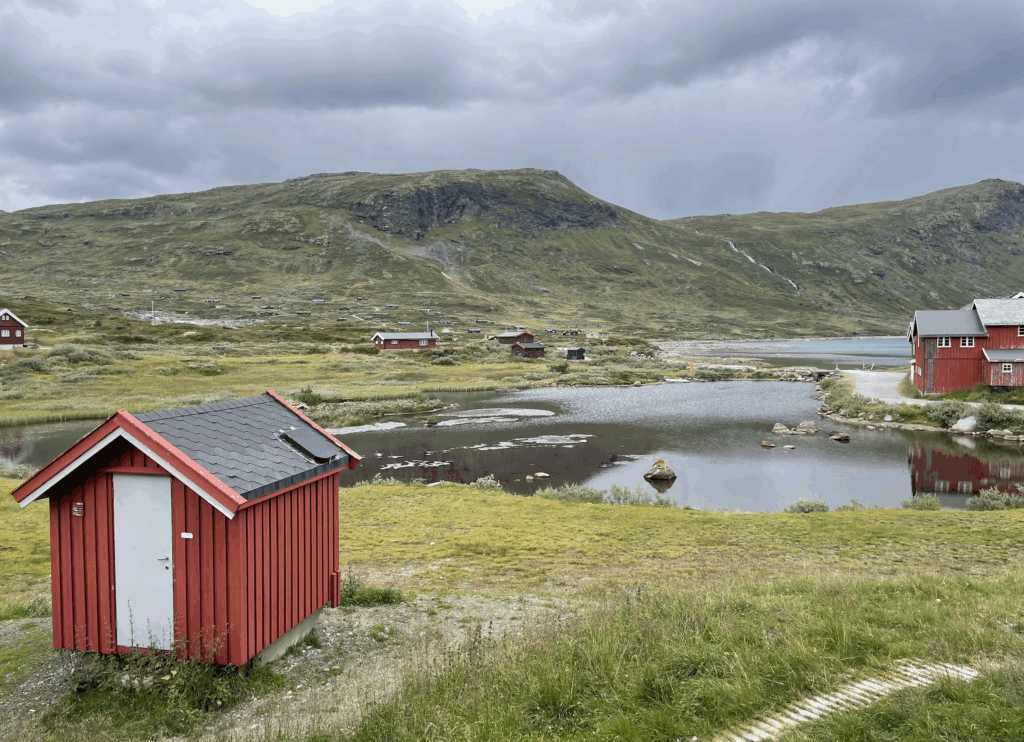
Our first day of cycling introduces the Norwegian “parcours”. We have brief periods on tarmac. But most of our travels are undertaken on gravel tracks that criss-cross the region. Occasionally they are a bit choppy (all our group are riding modern gravel bikes). However most of the gravel is so hard-packed and well maintained that most could be easily ridden on any touring cycle, trike, recumbent and even most road cycles. The smoothest gravel even puts some of the tarmac in and around Cardiff to shame! They make for great two-wheeled transit; partly because they’re all but deserted, and partly because they wind their way through jaw-droppingly beautiful scenery. Over four days riding the guides skillfully ramp up the visual splendour. We cycle through high mountains, over plateaus, through forests and around lakes. We spy fjords, waterfalls and glaciers. It’s all magnificent, but the absolute highlight comes on the last day when we ride from Geilo to Flam, over the 1300m Rallarvegen “Navvies Road” mountain pass. It’s nature turned up to eleven, and easily one of the most amazing days I’ve ever spent on a bicycle. Again, there’s hardly a vehicle on the route, just the odd farmer tending hardy sheep and cattle. Despite the remoteness though, we’re not alone on the trail. Joyfully, we see Norwegians of all ages out enjoying the route. There are young mothers and fathers out running with jogging strollers. We see a smiling gaggle of male joggers; to a man white haired and 70-plus I suspect. There are touring cyclists with bulging panniers. We pass a lady, surely well into her 80s, striding purposefully up the trial with walking poles. This all embodies something else I love about Norway; how they embrace the outdoors. In my experience, this attitude will persist into Winter; folk will just trade Summer footwear for skis and snowshoes.
This embracing of travelling actively persists in the towns and cities. Despite the isolation of much of our route, at times we descend into towns for meals or overnight accommodation. When we do, it’s usual to benefit from a wide network of shared use paths, usually set well back from the road. You won’t find any blue paint or plastic bollards here, shoehorned onto an already overcrowded road infrastructure by a local authority trying to somehow reverse decades of poor urban design decisions prioritising the motor car. Unlike Wales and the wider UK, Norway has clearly been getting this stuff right for decades. Just like on the Rallarvegen pass, we see a wealth of users: Pedestrians, joggers, cyclists and scooter pilots enjoying safe and relaxed transit away from motor vehicles. Despite the challenges nature throws at Norwegians, they seem to be able to “do” infrastructure of all sorts. Again, come Winter, these same paths will be kept clear enough to facilitate travel by skis, snowshoes and stout boots. Every mountain lodge and hotel we used enjoyed flawless high-bandwidth Wi-Fi. In the high mountains, and through Kilometre long tunnels on our bus transfers, I retain better 4G and 5G mobile coverage than I manage in my own home in the Cardiff suburbs. As we climbed and descended the Rallarvegen pass, we frequently spied the main railway line from Oslo to Bergen that traverses the mountains via Finse, the highest railway station in Norway. This station sits at 1222 Metres above sea level. Yr Wyddfa’s peak is at 1085 Metres. Wintery passage along the railway line is eased by snow blowers, gargantuan catch fencing to keep snow drifts and avalanches off the line, and artificial tunnels as barriers to snow and rockfalls. I suspect line closures are rare. Hailing from a nation where leaves on the line halt trains, it is spellbinding engineering. I love it.
With time to kill on our final day bus transfer, I inquisitively Google details of public health here in Norway and back home. A 2022 report by the WHO ranked the UK third highest for having the most obese adults of the 52 countries in the WHO European region (1). The same report catalogues a stark list of conditions associated with obesity, including liver and kidney disease, respiratory diseases, musculoskeletal complications, cardiovascular diseases, mental health problems, diabetes and 13 different cancers. Norway routinely fairs better across multiple measures. It’s rare I find statistics for Wales alone, commonly being wrapped up in a United Kingdom figure. One of the few figures I do find makes for uneasy reading: The same WHO report quotes the prevalence of overweight and obese 11 year olds: In Norway it’s around 9% of girls and 18% of boys. In Wales it’s around 21% of girls and 29% of boys. Different WHO data (2) reveals (compared to the UK again) a lower expenditure on health in Norway (as a % of GDP), longer life expectancy for both women and men, and a life expectancy rate increasing year on year at nearly double the rate in the UK. I idly wonder how the food, infrastructure, embracing of the outdoors and active travel that I love in Norway contribute to this widening gulf between our nations.
My latest two-wheeled foray into Norway is probably the best of all my trips there. Sure enough, the hidden landscape underneath the snow is beguilingly beautiful and spectacular. Everything about the trip reinforces my love for the country. It will never replace Cardiff and Wales in my affections. But I can’t help thinking that, as a city and a nation, we might benefit from being a bit more Norway…
(1) WHO European Regional Obesity Report, 2022, World Health Organization Regional Office For Europe.