Review: Panorama – E-Bikes: The Battle for Our Streets
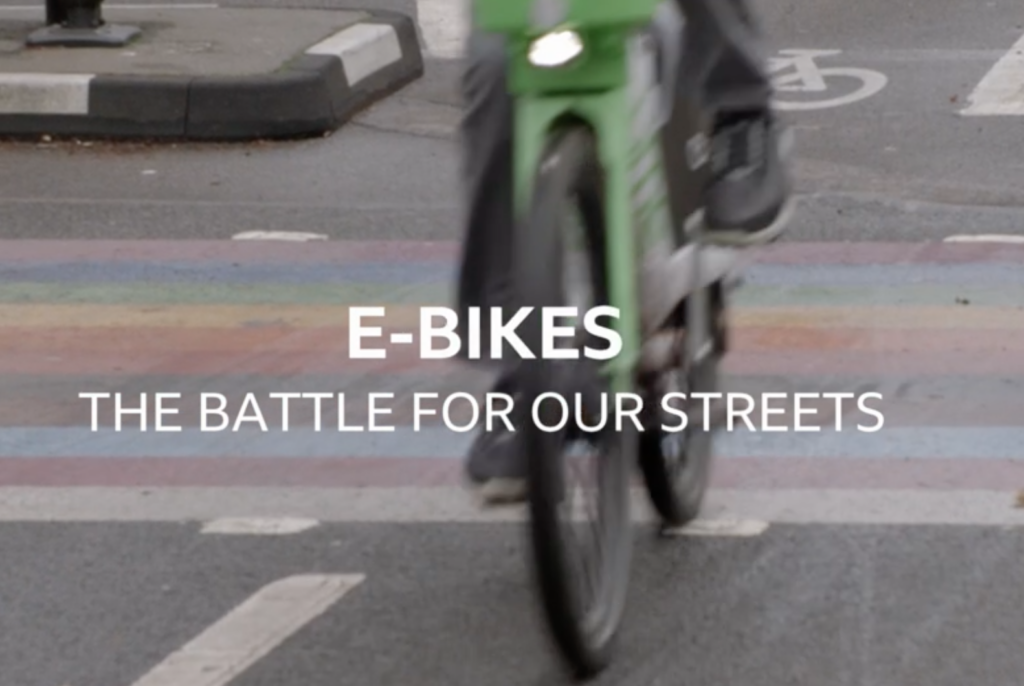
The term “e-bike” is a pretty big blanket which covers a wide variety of electrically-powered cycles. The exponential growth of delivery services such as Uber Eats and Deliveroo has seen a massive increase in the number of electrically-assisted bikes on our streets.
There’s been a great deal of debate, some of it constructive, but a lot of it purely divisive, about the dangers posed by these new arrivals in our shared city spaces. As with many issues in the age of social media and culture wars, the debate has become polarised, with little room for compromise or reasonable discussion.
As is so often the case, the debate has been picked up by what we should probably call the “traditional” media, in this case the venerable BBC Panorama, who have devoted 30 minutes to the topic of e-bikes.
As a title, “The Battle for Our Streets” doesn’t augur well in setting the angle the show is looking to take. During the piece, the presenter (professional curmudgeon Adrian Chiles) freely admits he approached the enterprise “kind of grumpy about e-bikes.”
The programme begins with a series of clips of people behaving badly on e-bikes. In his introduction, Chiles intones, “You might ride one to work. You might have your dinner delivered on one. You might just find them a nuisance.” On screen, a person on an electric Lime bike rides across a pavement, and then another crashes into a pedestrian, knocking them both to the ground. These evil contraptions are clearly a menace!
Our first contributor is Stephen Bird, Senior Reporter at the Daily Telegraph (that well-known bastion of balanced, evidence-based debate). He tells us that the e-bike is “a very dominant form of transport.” Let’s leave that statement hanging in the air for a minute as we move on to what a tabloid caption would probably call “SHOCKING FOOTAGE.”
A man rides an e-bike at 45kph. A crash test dummy on a bike smashes into an open car door (yes I know!), as Chiles grimly chimes, “with potentially devastating consequences.” E-bikes are “convenient for criminals,” we are told, as we watch police helicopter footage of a person speeding away from their pursuers on what is clearly an electric motorcycle, not an electrically-assisted pedal cycle. This is an important distinction which is never properly explained throughout the programme.
On with the show. LONDON! Adrian is trying out an e-bike for the first time. It’s a Lime bike. For those of you not familiar with Lime bikes, they’re a ubiquitous electric hire bike widely available in London. They don’t need docking stations, so can often be found piled up on pavements, causing all sorts of bother for pedestrians.
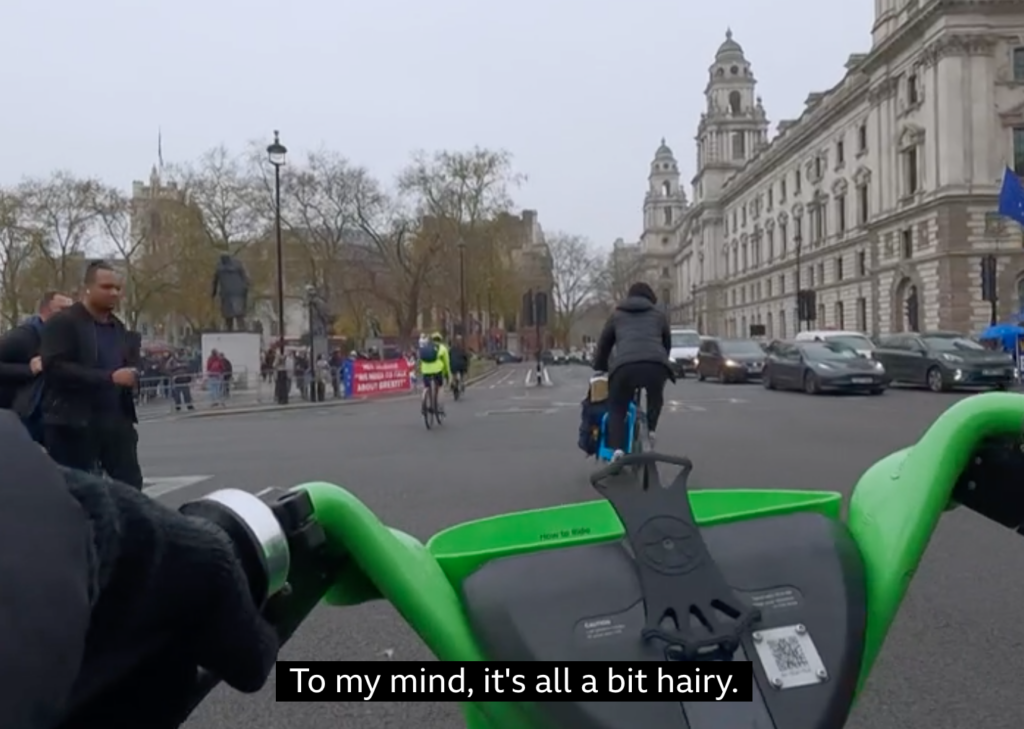
“They’re almost too easy to get used to,” he remarks, as if this is somehow a bad thing. Surely utility hire bicycles by their very purpose should be easy to use and accessible? OK, let’s move on.
“These are an absolute doddle to ride, it’s just a cheat. That’s because the electric motor’s doing the hard work, not me,” he adds, whilst clearly pedalling the bicycle on a flat road surface. We should probably let him off, as it’s his first time and he’s still learning the basics about how e-bikes work.
Time for some vox pops. One gentleman seems a bit confused: “There are no rules. No. There are rules.”
Adrian agrees: “That bike lane on the Embankment. I’d rather try and get on the M6 in the rush hour.” Yes, that’s right, a two-way segregated bike lane with just bikes on it is apparently more dangerous than an four-lane motorway packed with multi-ton vehicles driving at speeds in excess of 50mph.
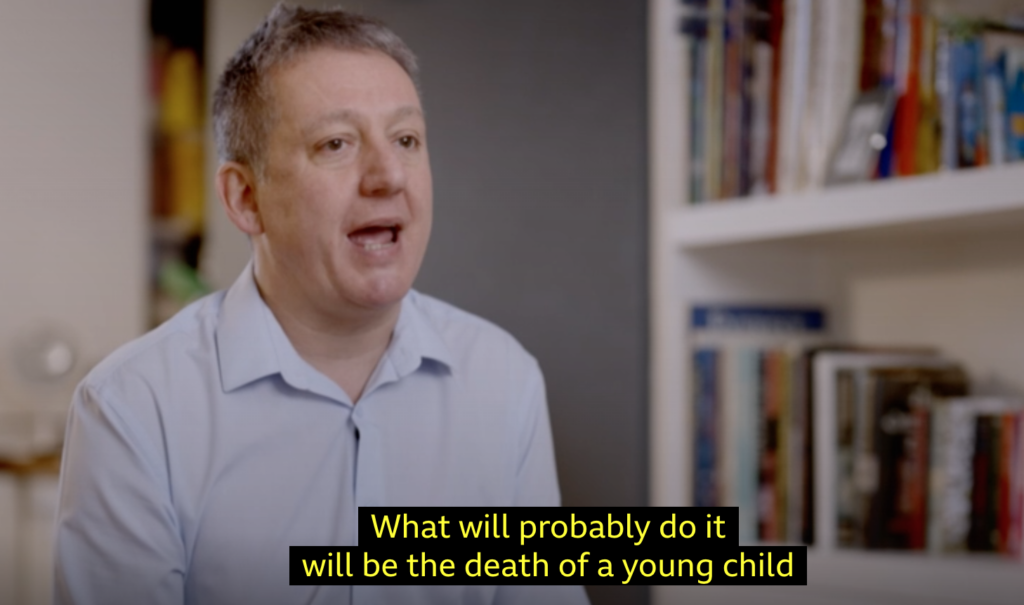
Time for some common sense in the form of Dr Alex Nurse, who works on Urban Planning at Liverpool University. He explains how e-bikes remove a lot of the barriers that exist which may prevent people from cycling.
Over the past 4 years, councils across England have spent around £750 million on cycling infrastructure such as bike lanes. This is a response to the UK’s commitment to cutting carbon emissions in the drive to reach net zero. Dr Nurse explains how Active Travel is a key part of reaching this goal.
But now back to our man from the Telegraph. These schemes haven’t been thought through. What about the impact on pedestrians?
Just wait until he hears about what cars do!
Next we’re off to Oxford to meet a member of the local pedestrians association. This would be a really helpful contribution except it trips up yet again on the lack of definition of “e-bike.” The segment is illustrated with a series of clips of people riding what are clearly electric motorcycles, whilst we are told that “e-bikes” should be re-classified so they can only be ridden on the road.
This is sloppy journalism and presents a dangerously inaccurate representation of the very subject of the programme. The viewer is led to interpret “e-bike” to mean “electric motorcycle,” which is clearly a false interpretation. Grouping together two very different types of vehicle into one amorphous lump and putting a big DANGER sign underneath it probably helps to boost viewing figures, but it poisons the well of debate.
We are told that these bikes should not be ridden on the pavement or in pedestrian areas; but these things are already illegal. This reveals the unspoken, recurring theme of the piece: lack of enforcement. The dangerous behaviour and dangerous bikes on show are all illegal under existing legislation. What’s lacking are the resources to enforce this legislation to reduce dangerous behaviour and seize dangerous bikes.
Here in Cardiff, the council and police work in partnership to crack down on the use of illegal electric motorcycles and cycling in pedestrian areas where it’s prohibited. There are wardens and officers on Queen Street most days, for example.
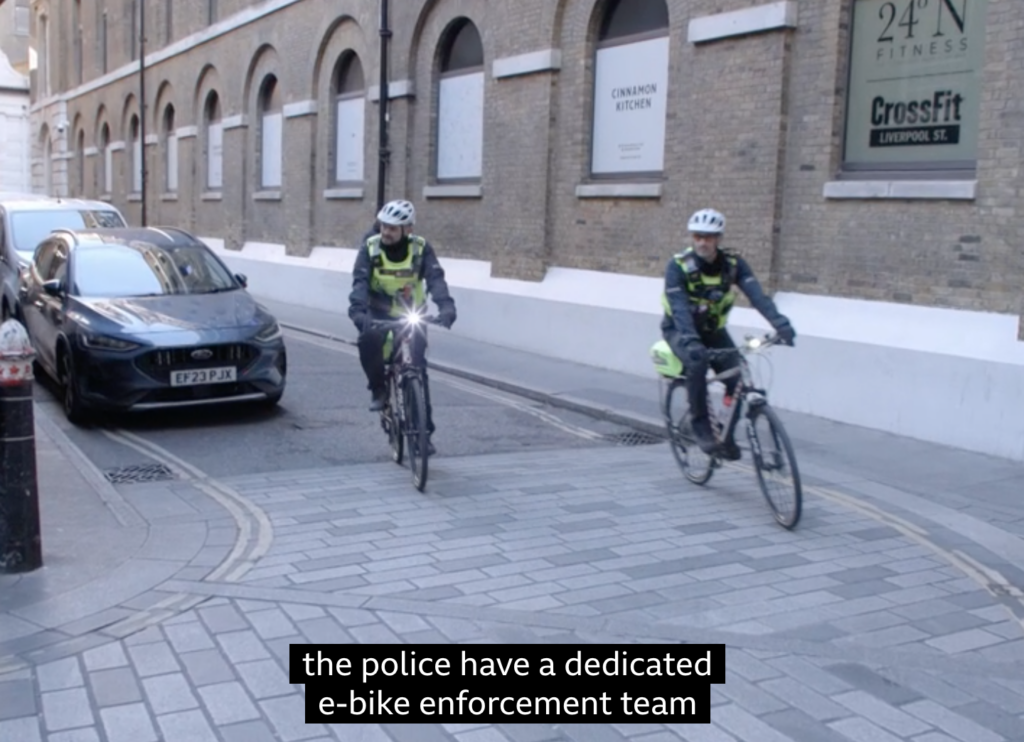
But as with most technical advances, law enforcement is playing catch-up. The exponential growth in gig economy delivery services like Deliveroo and Uber Eats has led to a massive increase in the prevalence of illegal electric motorcycles on our streets. At the moment we simply don’t have the resources to clamp down on them effectively.
From the evidence of this programme, it seems that the delivery companies themselves only pay lip service to the regulations regarding electric cycles. They don’t care about the welfare of the people who work for them, so why would they care about the safety of the bikes they ride?
Still in Oxford, we hear from Councillor Louise Upton, Planning and Cycling Champion. Oxford Council have spent £17.5 million on Active Travel infrastructure in the last 4 years. On the face of it, that might sound like a lot of money, but in relative terms, compared to other capital expenditure, it is a minute figure. For Oxford’s council taxpayers it equates to about £1.50 each per year.
In spite of this investment, there is still very little segregated cycling infrastructure, meaning that motorists, pedestrians and cyclists are still forced to share the same spaces.
“It really depends on everyone behaving well, and that is not always a given,” says Cllr Upton.
Next we move on to a quite frankly sinister encounter with an e-bike collector in some woods outside Bicester. It’s like a scene from an episode of Silent Witness. Adrian is shown an array of electric death machines, some of which are capable of speeds in excess of, gulp, 30mph. None of them are cars.
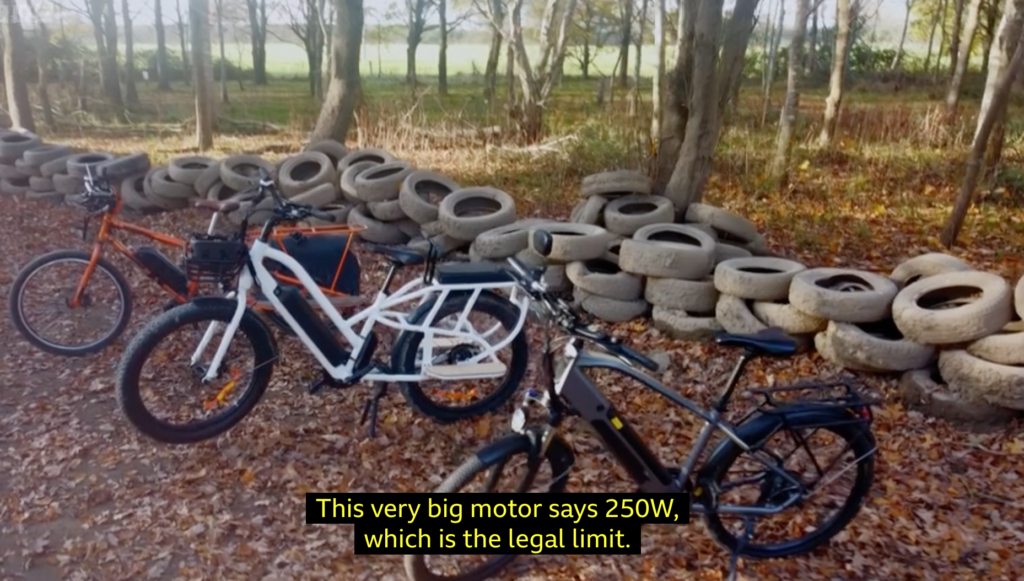
Adrian rides his motorbike at a leisurely speed alongside what we’re invited to believe is the most dangerous bike of the lot. This whole segment is bizarre. But at least we finally get some facts about the characteristics of a “legal” e-bike. You have to be 14 to ride one. The motor can’t be more than 250W and it should only work if you’re pedalling, and must cut out at speeds over 15.5mph.
We learn that some e-bikes have throttles (like a motorbike), but by law they have to be sold with the throttles disabled. Some quick googling will help you find a way to unlock the throttle, of course.
Back at home, Adrian does some more googling. He quickly finds an array of powerful electric cycles with specifications which make them illegal to ride in the UK. They’re readily available to order; you can even get one on the Cycle to Work Scheme!
We’re back to our unspoken recurring theme again. Selling e-bikes which are either outright illegal or capable of being modified to make them illegal – it’s clearly happening on an industrial scale but there is no enforcement, no deterrent.
Time for more scary crash test footage. We’re off to Switzerland!
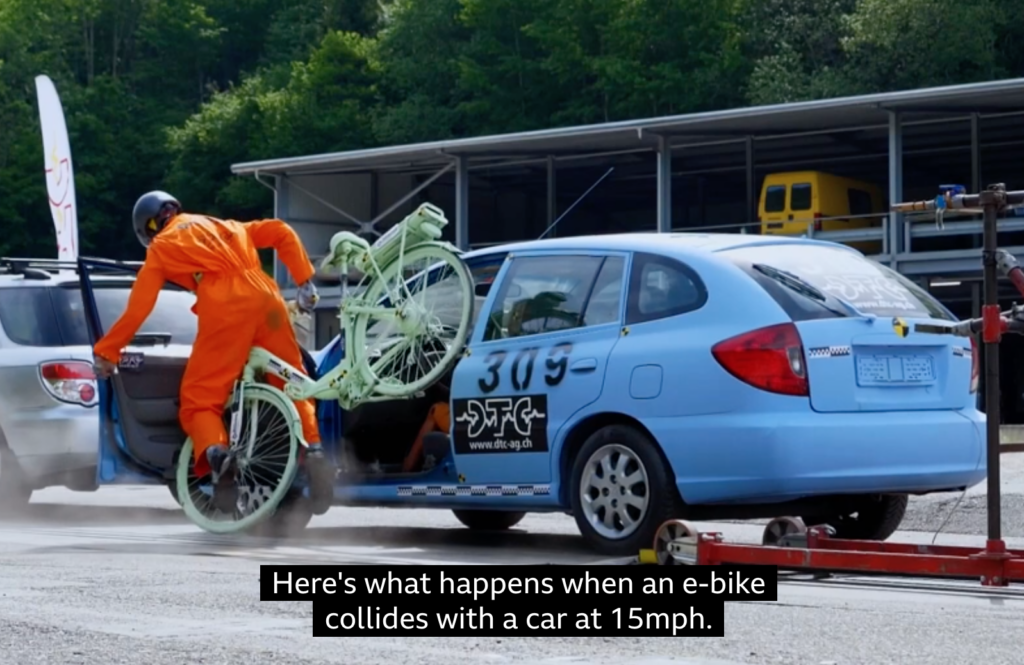
It’s curious, but most of the clips seem to involve bikes in collisions with cars. We are told that the severity of pedestrian injuries from collisions with e-bikes are often comparable with those sustained in collisions with cars. I’d love to see the physics behind that statement!
In the final segment, we look at what can be done to reduce the harm caused by electric cycles, and whether more regulation is required. It seems an odd approach to speak about more regulation, when we’ve spent the last half hour being told about all the things that are already illegal. Surely better enforcement is a big part of the solution?
The biggest part of the solution, as Dr Nurse tells us, is dedicated infrastructure.
The other question which remains unasked is, should we consider that there might be more to road violence than just dodgy e-bikes? Is there a much greater threat that we’ve known about for a much longer time than e-bikes have been around? A threat that’s been growing for years and years?
Perhaps a future episode of the programme could take a look at cars.
The views expressed in this post are those of the author and do not necessarily reflect those of Cardiff Cycle City.