Electric Mountains – How I Joined the E-Bike Revolution

For many reasons, Mallorca is one of the world’s best cycling destinations. The (generally) warm, dry climate is perfect for cycling and the many country back roads are quiet and well-maintained, so you can enjoy the beautiful rural and coastal scenery without worrying that you’re going to come a cropper in a pot hole.
I’d like to share my own recent experience of cycling on the island.
In the towns there is plenty of excellent cycling infrastructure; we stayed in Port de Pollensa, which has a two-lane cycleway running most of the length of its sweeping bay. Even the major roads have ample space to ride to the side of the main carriageway, and most drivers are very considerate when passing cyclists, because they’re just used to seeing them everywhere.
There are a lot of cyclists in Mallorca – from casual tourists of all ages, all the way through to professional teams on training camps. The hospitality and retail industries on the island are extremely well set-up to cater for cyclists of all levels. The hotel we stayed in had an on-site bike workshop, bike hire and a cafe selling cycling equipment and clothing (along with great coffee – Cortado, anyone?).
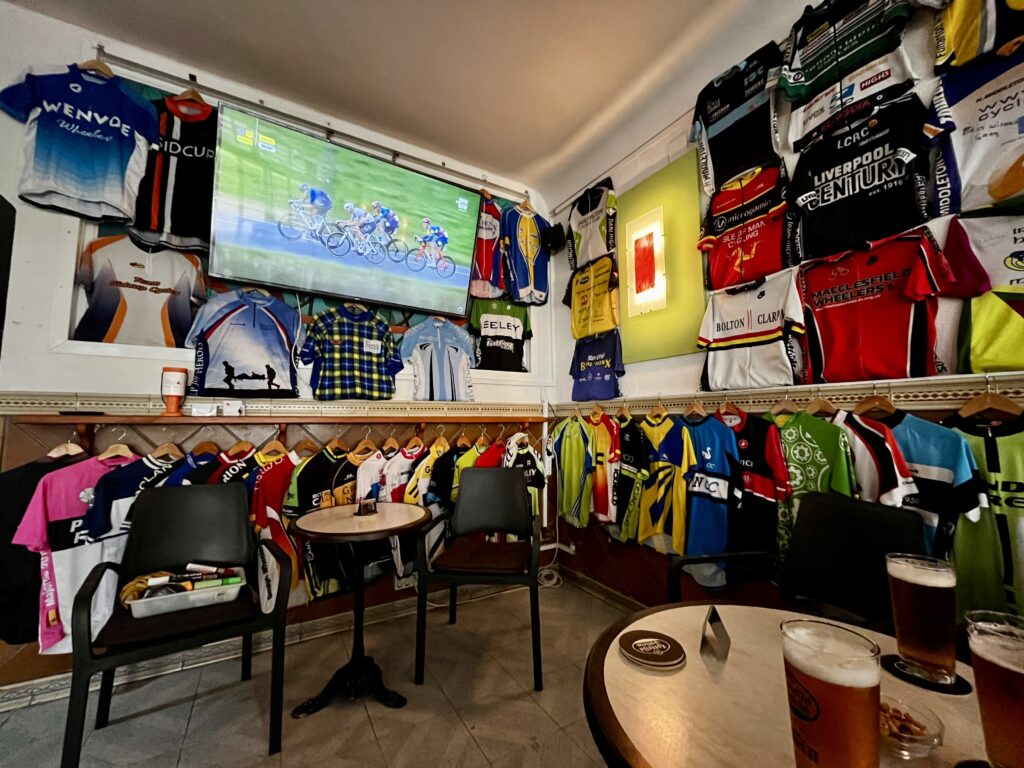
In addition to that, the hotel itself had made some really nice concessions to cyclists who were staying there. How often have you stayed at hotel and been told you’re not able to take your bike in the lift, or store it in your room? Not a problem in Mallorca. There were also several exceptional cycling cafes within a stone’s throw of the hotel, where we were able to watch the Ghent-Wevelgem classic race after our Sunday recovery ride.
I’d been looking forward to our trip for many months, but was conscious that for a number of reasons, my preparation for the challenging rides we were planning had not been good enough. One of our targets, the iconic Sa Calobra, was definitely beyond my capabilities right now.
So, as the date of the trip drew nearer, I decided that I would rent an e-bike. It would only cost an extra £50 for 3 days, which I thought was exceptional value in exchange for a bit of peace of mind that I wouldn’t fail to complete some of the routes we had planned.
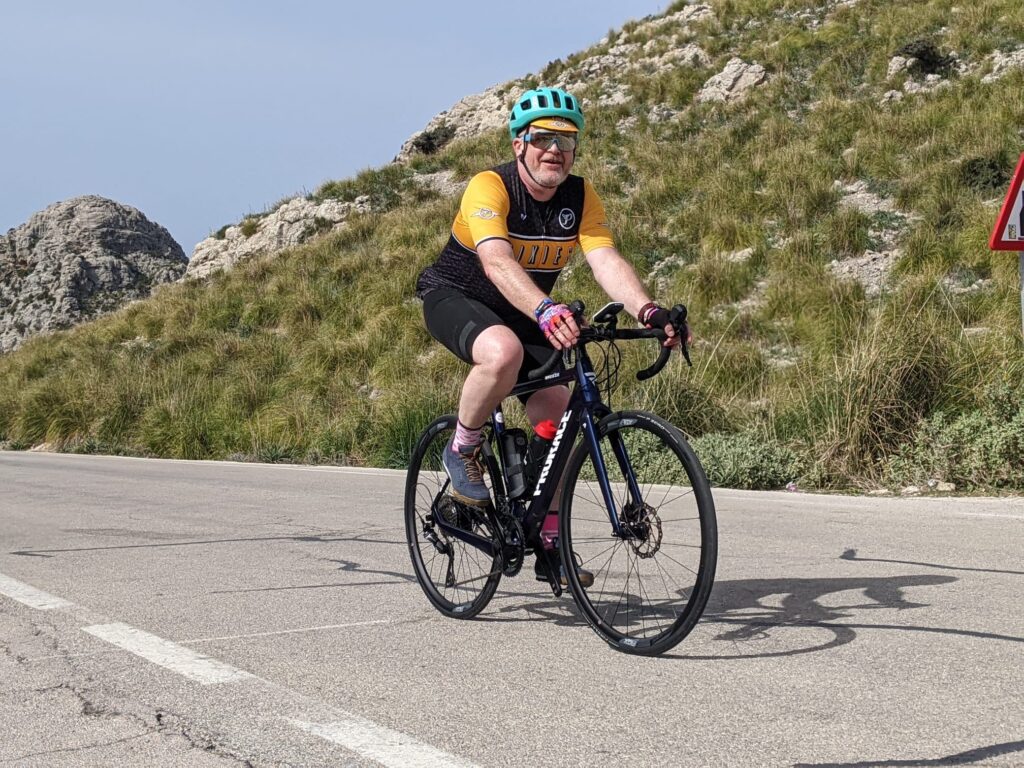
My companions had hired some really flash (but also excellent value) carbon road bikes with electronic shifting and other mod cons. My e-racer was made from carbon, with a Shimano 105 groupset and, crucially, a 250 watt hub motor! I had also upgraded to a battery extender, which consisted of a black brick-shaped object which sits in the bottle cage and plugs into a discrete plug just above the bottom bracket. The plug was a little bit too discrete for my fat fingers, and it took a few goes to make sure the cables were all plugged in. Needless to say, my bike was a lot heavier due to the electric components.
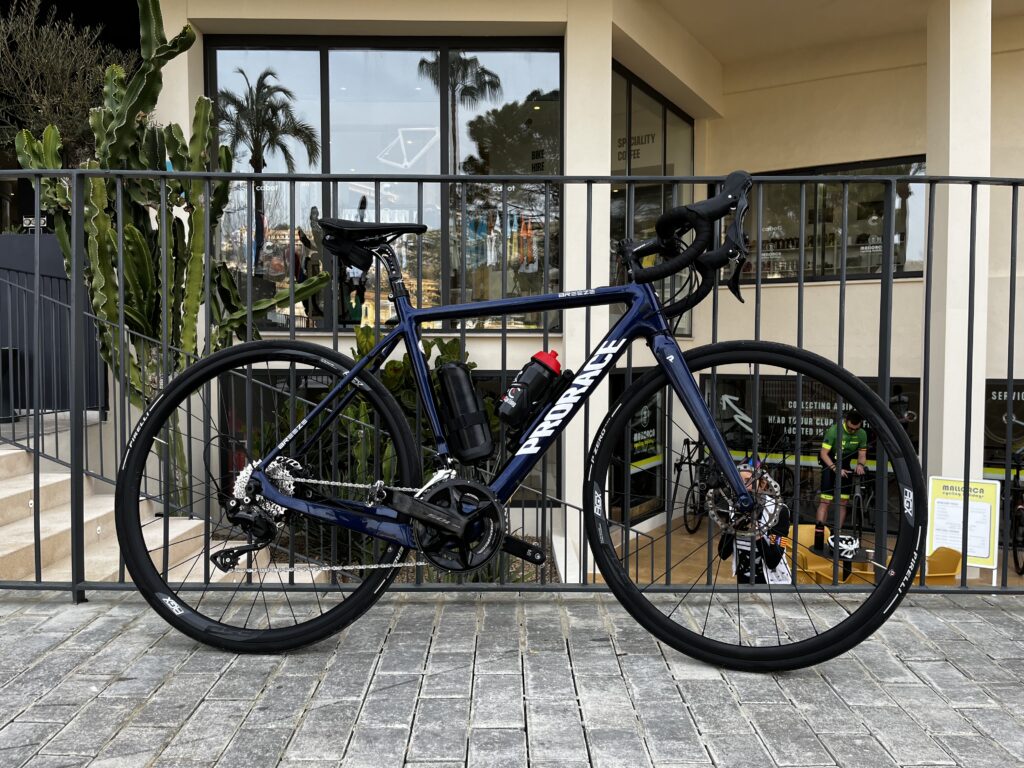
The e bike I was using was limited to 25kph, which means that the electric motor would cut out as soon as you reached that speed. This meant that on flat sections I was often riding under my own steam, and of course the heavier bike makes descending a lot easier too, in my experience.
The bike came with an app (of course!), which enabled me to check the battery levels during my rides and also during charging. I didn’t want to be setting off on a 100km ride with only 60% battery! The advertised range of the bike when kitted out with the extender was around 160km, although I knew that figure was based on riding on “average” roads.
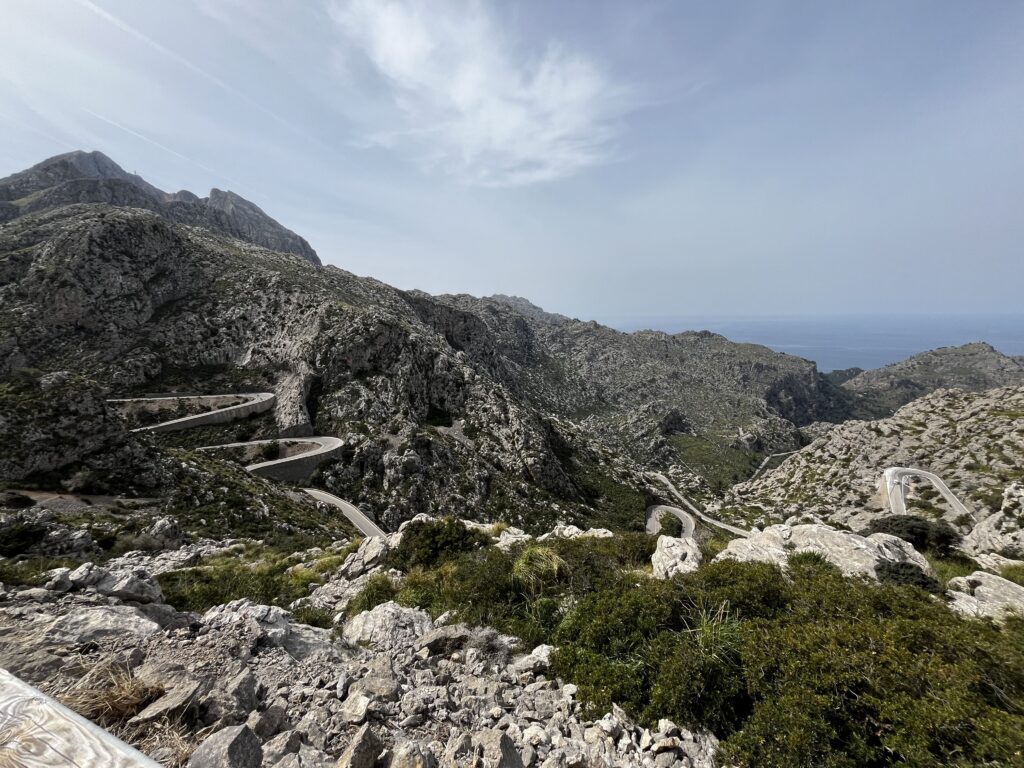
It won’t surprise you to know that there aren’t many average roads on the mountainous western side of Mallorca, which is where we were headed. The main climb of Sa Calobra, for example, is over 9km long with 650 metres of climbing at an average gradient of 7%! We would ride over 100km in total on the day we tackled Sa Calobra, climbing 2000 metres in the process. That was going to be a challenge for me and my e bike! I have to admit I was a little anxious as we set out at 9am. What would I do if the battery ran out halfway up a big climb? Would I have enough of my own energy left to ride a heavy bike the rest of the way up the hill, let along all the way home?
I was about to find out.
Spoiler alert: Sa Calobra wasn’t the only climb on this ride. First we had to tackle Coll de la Batalla, which is 8km at 5%.
The run in to the base of this climb was about 30km of benign rolling country roads. The e bike came with several different motor assistance settings:
Blue = Extra support
Pink = More support
Yellow = Slightly more support
Red = Most support (but battery will run down quickly)
I opted for Blue, because I knew how long it was going to have to last. As it turned out, Blue was just enough to keep me going at the same pace as my companions, all the way up the first climb. In fact, I was able to give them a wheel to follow which they were most grateful for at certain points!
When we got to the top of the Coll, we were already halfway through the ride in terms of distance travelled (50km). However, there was still around 1000m of climbing still to come. My battery level was at 67% remaining. Mathematically, it looked like I had enough juice to get there and back.
After some respite at the garage at the top of the Coll, and some bidon refills, we continued over the mountains towards the west coast, and Sa Calobra. On the way, we stopped by the roadside for some orange juice, which was freshly squeezed right in front of us by a very kind gentleman in a little nook next to a panoramic viewing point. We slurped the juice and took some photos, before pushing on to the top of the descent into Sa Calobra (Coll dels Reis).
This was where my motor could take a break, as we hurtled downwards around dozens of hairpins, occasionally glancing up to admire the spectacular rocky mountain scenery and shimmering blue waters of the Mediterranean in the distance. This ride was not for the faint-hearted, and it certainly triggered my fear of heights at several points. But it was exhilarating nonetheless. A true bucket-list ride.
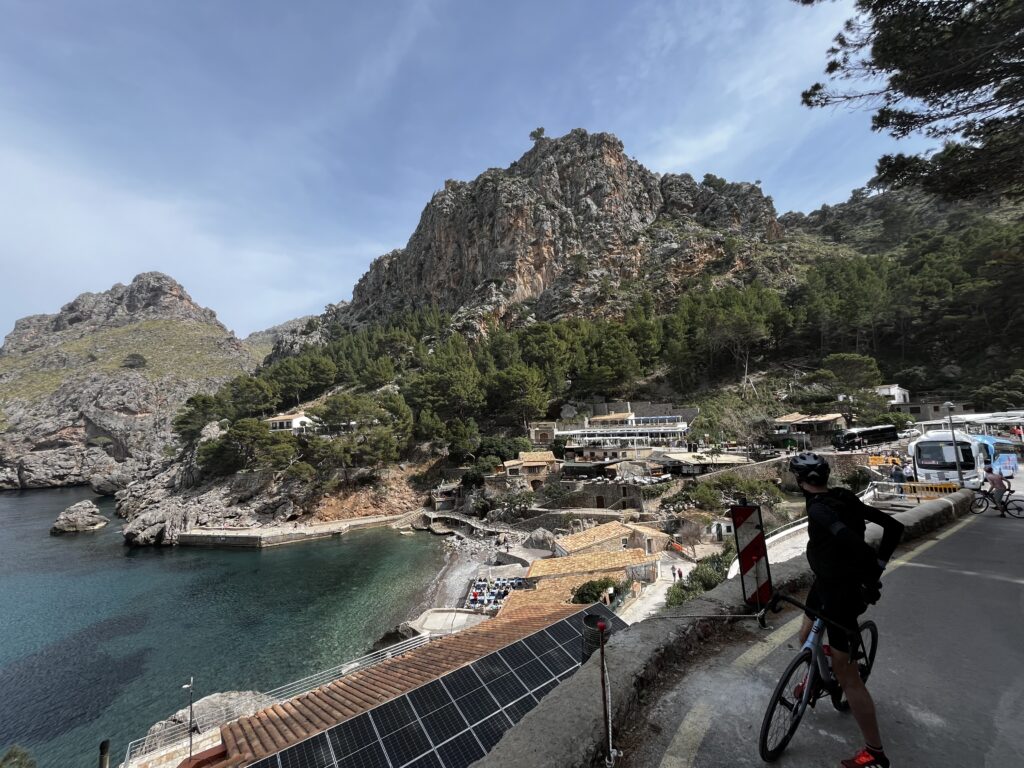
Soon we were at the bottom and enjoying a well-earned lunch in the sunshine. My battery level was now 50%. My anxiety level ticked up several notches. I tried to do some rough mental arithmetic about how much juice I would have left when, or perhaps if, I got to the top of the climb. After that, I would still need enough battery to get over the rolling terrain which led back to Port de Pollensa.
I told myself that in the worst case scenario I would call a taxi to take me and my heavy, dead bike back home. Or I would just slog it all the way home under my own power.
As we sat and watched several of Rafa Nadal’s buses negotiating the tight hairpins above the port, wondering how on earth they’d managed to make it down without doing an “Italian Job,” we knew it was time to head back up the mountain. We were all nervous. This climb is a massive challenge for even the fittest pro cyclists – except perhaps for Illi Gardner (30 minutes) and Tom Pidcock (24 minutes).
I would be content with just getting up there without having to give up and stop. It would probably be at least an hour of unrelenting climbing for me. I decided that I would just turn the pedals, using minimum electric power – if I went too hard I would risk draining the battery before the summit.
The ascent took me over an hour, but I was very happy my own internal batteries as well as the electric ones, hadn’t run out. We rested up for a few minutes and then headed back towards the Coll de la Batalla. Just before the garage, we made a sharp left turn and followed the beautiful undulating road along the ridge. Eventually our climbing efforts were rewarded with a sweeping descent almost all the way back into Port de Pollensa.
As rode back into the hotel car park, I was relieved to see that my battery still had 5% charge remaining! I’d like to say that this was due to diligent planning on my part, but it was more like sheer luck. I learnt a useful lesson about e bikes that day, for sure.
Some people might say that using an e bike is cheating. In response I would say that e bikes are a transformative technology which enables all kinds of people of all abilities to tackle routes that they would otherwise never been able to attempt. I’m very grateful for the opportunity that my e bike gave me to conquer one of the world’s toughest cycling challenges. Yes, there were points of anxiety, but there were also moments of sheer exhilaration and inspiration. My advice to anyone who is nervous about getting into cycling is, regardless of whether you’re just popping to the shops or riding up a mountain, try an e bike. You never know where it might take you.
Note: the views in this article are those of the author and do not necessarily reflect those of Cardiff Cycle City.